| |
Time: 12 hours Level: Introductory
| |
| |
Introduction Resource
- The Palaeozoic Era was a very important time in the history of life. Using evidence from fossils, we start by looking at the Cambrian explosion, when many forms of animal life first appeared about 545...
| |
| |
1.1 A burst of evolution Resource
- One of the most important events in the history of life began about 545 million years (Ma) ago, i.e. some four billion years after the origin of the Earth, and over 3.3 billion years after the origin of...
1.2 The Burgess Shale Resource
- High in the Canadian Rockies is exposed a deposit of middle Cambrian age, about 530 Ma old, called the Burgess Shale. It contains the fossils of animals that lived on a muddy sea floor, and which were...
1.3 An overview of animal phyla Resource
- We have already met quite a few different animal phyla, and it's useful to get an overview of all the ones commonly found in the fossil record and their mode of life before studying some in more detail....
1.4 The origin of the vertebrates Resource
- Vertebrates such as ourselves are by definition animals with a backbone (or vertebral column, paired limbs, a skull and various other structures. Until recently vertebrates were thought to extend back...
| |
| |
2 The Ordovician seas Resource
- Collecting seashells on an Ordovician beach would have been a rather curious experience. Whilst most shells were made of similar materials to those found on a modern beach, the detailed form of many would...
| |
| | 3 The Silurian Period and the invasion of the land
3 The Silurian Period and the invasion of the land Resource
- What global event had reduced global sea level at the end of Ordovician times, drastically affecting shallow marine organisms, and leaving the diversity of early Silurian life severely curtailed?
| |
| | 4 Life in the Silurian sea
4.1 Trilobites Resource
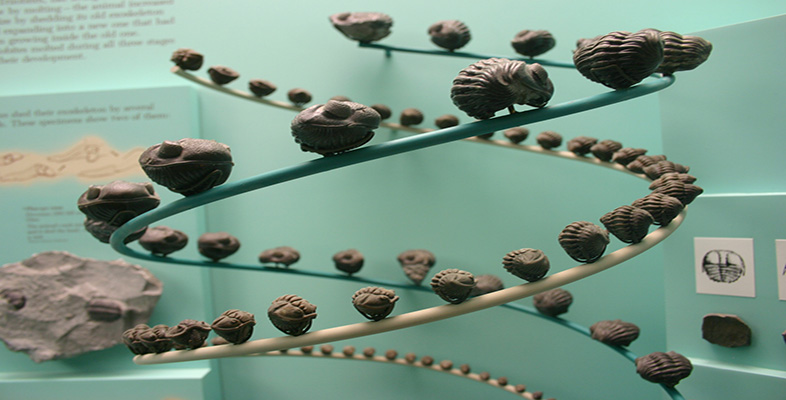
- As we've seen, the Cambrian explosion left the seas teeming with a huge variety of animals. In the following activity you will study some of the marine life at one particular time in the Palaeozoic Era...
4.2 Crinoids Resource
- Figure 7 shows the fossilised remains of a type of echinoderm called a crinoid (‘cry-noyed’). Although crinoids occur today, they were far more common in the Palaeozoic and Mesozoic Eras. Most crinoids...
4.3 Corals Resource
- Corals are especially abundant in the Wenlock Limestone.
4.4 Other Wenlock Limestone fossils Resource
- Among the other fossils common in the Wenlock Limestone are brachiopods (Figure 12a and b), gastropods (Figure 12c) and bryozoans (Figure 12d). You may need to reread Section 1.3 to remind yourself about...
| |
| |
5 The Devonian Period Resource
- Environmental change is known to have a significant impact on the evolution of life. For example, widening oceans generate barriers between populations and promote increasing genetic divergence between...
| |
| | 6 Vertebrates move onto land
6.1 A difficult evolutionary transition Resource
- As we saw in Section 3, the move out of water on to land was a particularly difficult evolutionary transition, requiring many adaptations.
6.2 An outline of vertebrate evolution Resource
- Let's now place the early evolution of tetrapods in perspective by taking an overview of the whole of vertebrate evolution.
| |
| | References and Acknowledgements
| |